
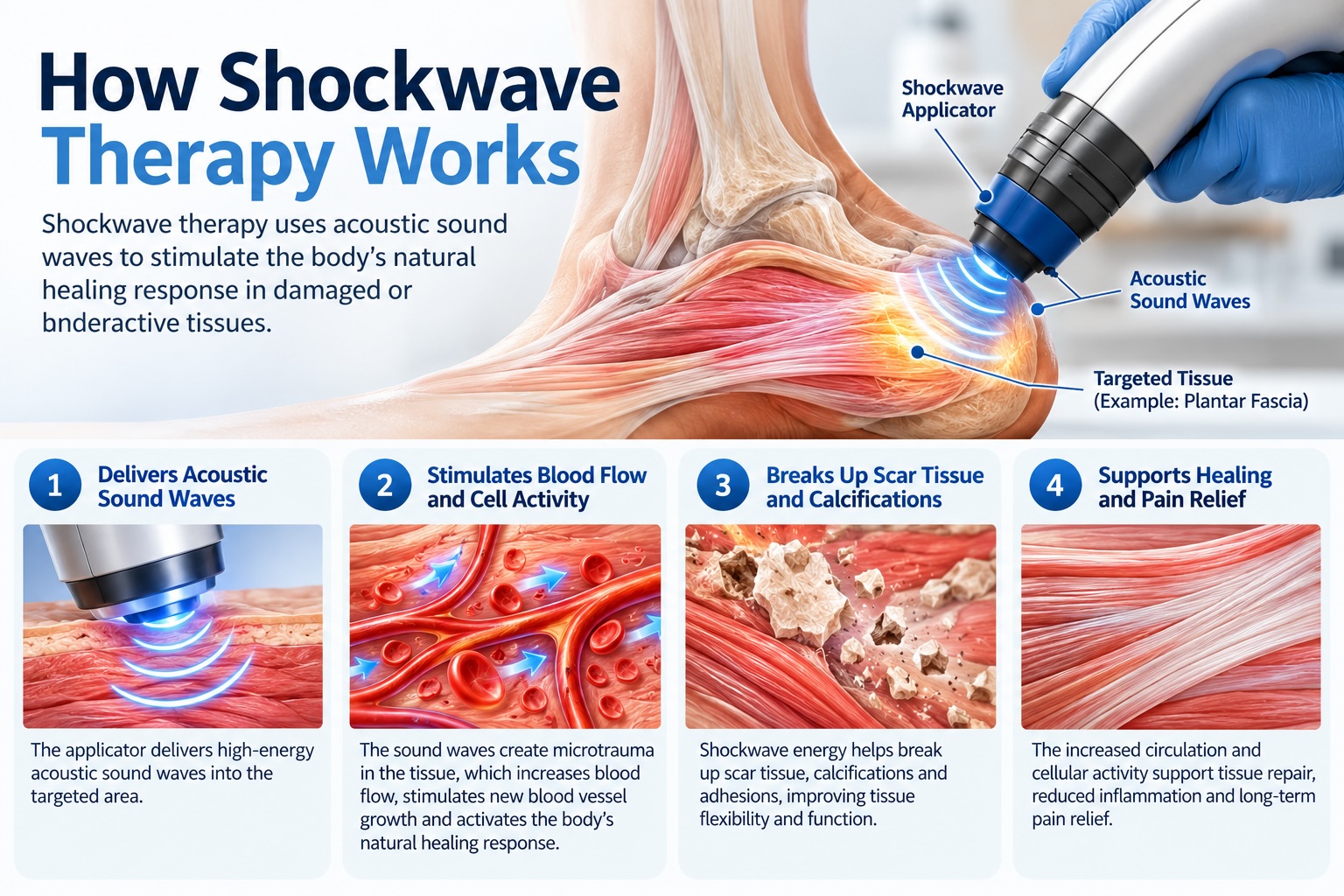
Shockwave therapy is a noninvasive treatment that delivers controlled acoustic pressure waves to targeted areas of the body.
These waves may stimulate local biological responses tied to circulation, tissue repair, pain modulation and healing — commonly used for musculoskeletal conditions and select neuropathy or nerve-related symptoms.
Shockwave therapy is designed to support the body’s natural healing response, promote healthy circulation, reduce pain and discomfort, and improve mobility and function when clinically appropriate. Most patients experience meaningful improvement over a series of treatments, individual results vary, and complete pain relief or nerve regeneration cannot be guaranteed.

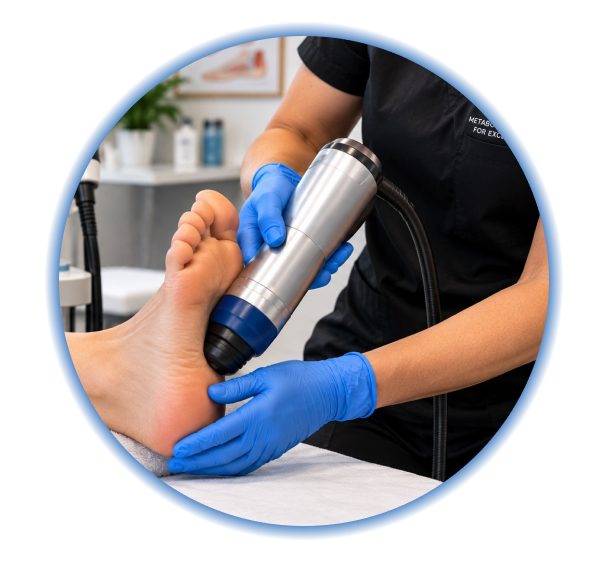
Shockwave therapy may also be called extracorporeal shockwave therapy (ESWT), radial pressure-wave therapy, focused shockwave therapy or acoustic-wave therapy. A handheld device is applied to the skin over the affected area, delivering a series of acoustic pulses into the tissue beneath.
During treatment, a handheld device is applied to the skin over the affected area. The device delivers a series of acoustic pulses into the tissues beneath the skin.
Depending on the condition being treated, shockwave therapy may support:
The treatment does not require:
Depending on the condition being treated, shockwave therapy may support local circulation, pain reduction, tissue remodeling and cellular repair processes.
For neuropathy, damaged nerves may send pain signals without an obvious injury, or fail to properly transmit sensations like pressure, temperature and touch. Research into shockwave therapy for peripheral nerve conditions is continuing.
Proposed effects may include:
Some patients may experience reduced pain and improved function, while others may have a more limited response.

Effects vary by condition, treatment area and individual response.
Potential supportive benefits may include:
Pain & Circulation
Local circulation
Reduced localized inflammation
Pain reduction
Tissue Repair & Healing
Tissue remodeling
Cellular repair processes
Biological processes involved in tissue healing
Movement & Relief
Improved movement and function
Release of tight or painful soft tissue
Support for the healing response
Certain chemotherapy medications can damage peripheral nerves, causing a condition known as chemotherapy-induced peripheral neuropathy, or CIPN.
Symptoms may begin during cancer treatment or develop afterward. For some patients, symptoms improve once chemotherapy is completed. For others, neuropathy may continue for months or years.
Possible Symptoms
Chemotherapy-related neuropathy may cause:
At MCE, eligible cancer survivors may be evaluated for shockwave therapy and other supportive treatments intended to reduce symptoms and improve function.
Patients with active cancer or ongoing oncology treatment may require clearance from their oncologist before beginning shockwave or laser therapy.
Shockwave therapy does not treat cancer and should never replace oncology care.
Diabetes-related neuropathy develops when elevated blood sugar and other metabolic factors damage nerves and the small blood vessels that supply them.
Symptoms often begin in the toes and feet and may gradually move upward. The hands can also become affected.
Possible Symptoms
Shockwave therapy may be considered as part of a broader care plan for selected patients with painful diabetic neuropathy.
It does not replace blood-sugar management, foot care, prescribed medication or routine diabetes monitoring.
Peripheral neuropathy refers to damage involving nerves outside the brain and spinal cord.
It can result from many different conditions, including:
Because neuropathy has many possible causes, MCE begins with an evaluation rather than assuming that every patient has the same condition.
Treatment recommendations depend on the patient’s symptoms, health history, examination findings and underlying diagnosis.
Sciatica refers to pain or other symptoms that travel along the path of the sciatic nerve.
Symptoms may begin in the lower back or buttock and extend into the thigh, calf or foot.
Common Symptoms
Sciatica can result from disc problems, spinal narrowing, inflammation, muscle-related compression or other conditions.
Shockwave therapy does not correct every cause of sciatica. It may be considered when painful muscles, connective tissues or related soft-tissue restrictions are contributing to symptoms.
Patients with significant weakness, bowel or bladder changes, saddle numbness, rapidly progressive symptoms or severe neurological findings require prompt medical or emergency evaluation.
Nerve-related pain may feel very different from muscle or joint pain.
Patients often describe it as:
Nerve symptoms may result from damage, inflammation, compression, reduced circulation or an underlying medical condition.
MCE evaluates the pattern of symptoms and may recommend additional testing or specialist referral when the diagnosis is unclear.
Shockwave therapy may also be used for selected pain conditions involving muscles, tendons, connective tissues and joints.
MCE may evaluate patients with:
Not every painful condition is appropriate for shockwave therapy. A clinical evaluation is needed to determine whether treatment is likely to be safe and beneficial.
A comprehensive plan may include several approaches — shockwave therapy is often one part of a broader treatment program.
When possible, treatment begins by addressing the condition causing or contributing to nerve damage.
This may include:
Medications commonly used for neuropathic pain may include:
These medications may reduce symptoms but do not necessarily repair the underlying nerve damage.
Physical therapy may help improve:
Depending on the condition, patients may benefit from:
Additional treatment options may include:
Shockwave therapy may be considered when the provider determines that a localized pain, tissue or neuropathy-related condition may respond to acoustic-wave treatment.
Consider scheduling an evaluation if you are experiencing:
Sensory Symptoms
Burning
Tingling
Numbness
Pins and needles
Sharp or shooting pain
Increased sensitivity
Functional Symptoms
Difficulty walking
Reduced ability to stand
Trouble exercising
Poor balance
Frequent tripping
Difficulty sleeping
Musculoskeletal Symptoms
Chronic foot or heel pain
Tendon pain
Muscle tightness
Localized tenderness
Reduced range of motion
Pain with activity
Symptoms alone do not determine whether shockwave therapy is appropriate — their underlying cause must first be evaluated.
Chemotherapy-related neuropathy
Diabetes-related neuropathy
Peripheral neuropathy
Nerve pain
Suspected nerve damage
Sciatica-related pain
Chronic musculoskeletal pain
Foot and heel pain
Reduced mobility
Selected tendon and soft-tissue conditions
Treatment is not automatically appropriate based on diagnosis alone — a clinical evaluation determines whether it is likely to be safe and beneficial.
Patients may feel tapping, pressure or temporary discomfort during treatment. Sessions are generally performed in the clinic without surgery or anesthesia.
The number of treatments depends on:
Some musculoskeletal conditions may use a shorter treatment series. Chronic neuropathy or complex pain conditions may require a longer individualized plan.
At MCE, treatment progress is periodically reassessed. Patients should not be promised a guaranteed result or a specific level of improvement.
Some patients return to normal daily activities immediately. Others may experience temporary:
Improvement may develop gradually as the body responds to treatment.
Patients should follow the activity and aftercare instructions provided by their MCE treatment team.
Shockwave therapy may not be appropriate for every patient.
Potential contraindications or precautions may include:
Patients with a history of cancer may require oncology clearance depending on their cancer status, treatment history and planned treatment area.
Neuropathy and chronic pain are not the same for every patient — we do not assume that all burning, tingling, numbness or radiating pain has the same cause. Our team evaluates each patient’s symptoms, function, health history and risk factors before recommending treatment.
Depending on the patient’s needs, the MCE evaluation may include:

Patients with significant weakness, foot drop, rapidly progressive symptoms, one-sided neurological findings or an unclear diagnosis may be referred for EMG/nerve-conduction testing, neurology, vascular, podiatry, orthopedics, spine, pain-management or oncology follow-up.
Depending on the patient’s diagnosis, MCE may recommend a personalized combination of:
Patients choose Metabolic Centers for Excellence because our approach emphasizes:
Individualized evaluation
Noninvasive treatment options
Care for multiple neuropathy types
Support for chemotherapy-related neuropathy
Support for diabetes-related neuropathy
Treatment of peripheral neuropathy/nerve pain
Care for sciatica/chronic musculoskeletal pain
Objective screening and testing
Multiple treatment modalities
Ongoing progress monitoring
Coordination with other healthcare providers
Appropriate referral when needed
Our goal is to help patients reduce symptoms, improve function and regain confidence in their daily activities.
Shockwave therapy may be an option for patients interested in noninvasive support for neuropathy, nerve pain or chronic musculoskeletal pain.
This webpage is intended for general educational purposes only and does not replace individualized medical advice, diagnosis or treatment.
Shockwave therapy may be considered for selected musculoskeletal, pain, tissue and neuropathy-related concerns following an appropriate medical evaluation.
Some uses of shockwave therapy, including certain neuropathy, nerve-damage, sciatica and chemotherapy-related applications, may be considered off-label depending on the device and condition being treated.
Patients should not stop or change diabetes medication, pain medication, blood thinners, chemotherapy-related medication or other prescribed treatment without direction from the prescribing provider.
Patients with active cancer or a recent cancer-treatment history may require clearance from their oncology provider before treatment.