
NAD+, or nicotinamide adenine dinucleotide, is a coenzyme found in every cell of the body. It plays an essential role in converting nutrients into usable energy and supports normal cellular metabolism, DNA repair and cellular responses to stress. (Cleveland Clinic)
At Metabolic Centers for Excellence, PushPatch® NAD+ therapy may be incorporated into an individualized wellness, pain, neuropathy or metabolic-care plan.
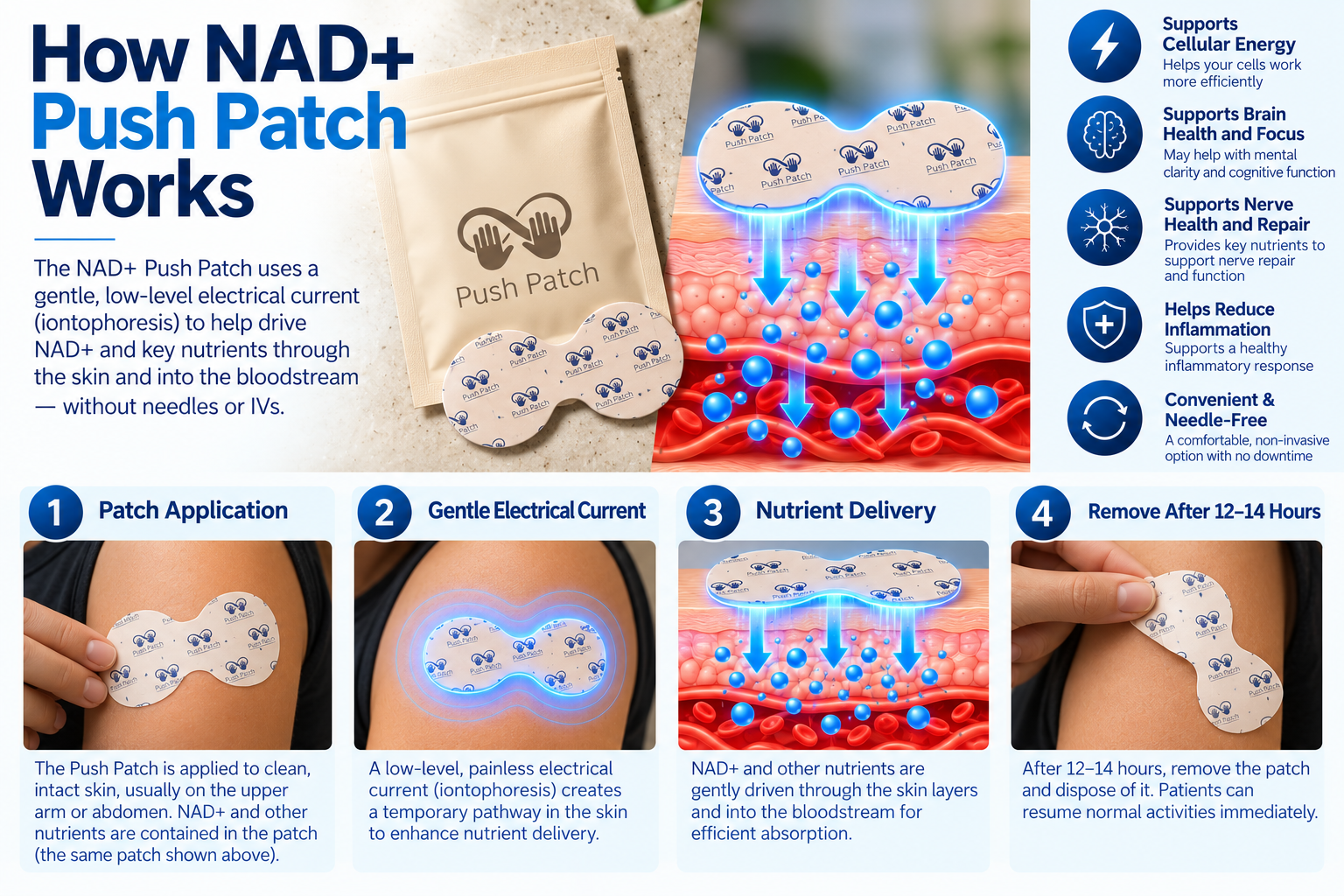
PushPatch® uses iontophoresis—a small, controlled electrical current—to help move charged NAD+ molecules through the skin. This provides a noninvasive alternative for patients who want NAD+ support without an intravenous infusion or injection. The manufacturer describes the patch as a prescription, single-use system that may be worn for up to 14 hours. (Push Patch)
PushPatch® is not intended to replace established treatment for neuropathy, diabetes, insulin resistance, PCOS, inflammatory disease or chronic pain. Clinical research has not yet established NAD+ patch therapy as a cure or standard first-line treatment for these conditions.


NAD+ is involved in many cellular reactions that help the body:
NAD+ and NADH work together to transfer electrons during cellular-energy production. Without this process, cells could not efficiently produce the energy needed for normal function. (Cleveland Clinic)
NAD+ levels may decline with age, and researchers continue to study NAD+ and how it may support health and function. However, human evidence remains limited, and researchers have not yet established the best delivery method, dose or clinical use for most NAD+ therapies. (ScienceDirect)
PushPatch® uses iontophoresis, a transdermal-delivery method that applies a low-level electrical current to help move charged molecules through the skin.
The system contains positive and negative electrodes. When activated, the electrical current helps repel charged molecules from the corresponding electrode and encourages their movement into or across the skin. Iontophoresis has been used in healthcare to enhance transdermal delivery while avoiding needles and the gastrointestinal tract. (Push Patch)
According to the manufacturer, PushPatch®:
Patients may choose PushPatch® because it offers a gradual, noninvasive form of NAD+ delivery.
Potential supportive benefits may include:
Cellular-energy support
Mitochondrial support
Recovery support
Support for normal cellular repair processes
Support for healthy inflammatory regulation
Reduced treatment time compared IV infusion
Needle-free administration
Convenient extended wear
An option for patients who cannot tolerate IV therapy
The presence of NAD+ in important metabolic and repair pathways provides a biological rationale for continued research. (Cleveland Clinic)
Neuropathy can cause:
Pain and neuropathy may involve nerve injury, impaired circulation, inflammation, mitochondrial stress or an underlying medical condition.
Because NAD+ participates in cellular-energy production, mitochondrial function and cellular stress responses, it is being studied for possible roles in neurological and regenerative health. The PushPatch® manufacturer lists pain management and neurological applications among its common uses. (Push Patch)
At MCE, PushPatch® may be used as supportive care within a larger neuropathy or pain-treatment plan. It may be combined, when appropriate, with:
Inflammation is a normal part of healing, but long-lasting inflammatory activity can contribute to pain, fatigue and chronic disease.
NAD+ participates in cellular pathways involving metabolism, stress responses and enzymes such as sirtuins. These pathways are being studied for their relationship to inflammatory regulation. The PushPatch® manufacturer describes reduced inflammation as a potential application. (Push Patch)
At MCE, PushPatch® may be considered as part of a treatment plan for improvement in the following areas:
PushPatch® should not replace medication or specialty care for autoimmune, inflammatory or infectious disease.
Insulin resistance occurs when the body’s cells do not respond normally to insulin. It is commonly associated with prediabetes, type 2 diabetes, metabolic syndrome, PCOS and excess abdominal weight.
NAD+ is necessary for normal energy metabolism, and researchers are investigating the relationship between NAD+ biology, mitochondrial function, obesity and type 2 diabetes. Lower NAD+ levels have been associated with metabolic disorders. (Cleveland Clinic)
For patients with insulin resistance, PushPatch® may be considered as a supportive wellness therapy, but it should be used only within a comprehensive plan that may include:
PushPatch® is not a substitute for diabetes medication, insulin, nutrition changes or ongoing metabolic monitoring.
Polycystic ovary syndrome is a hormonal and metabolic condition that may involve insulin resistance, irregular ovulation, elevated androgen activity, weight-management difficulty and increased long-term risk of type 2 diabetes.
NAD+ plays a general role in cellular metabolism.
For a patient with PCOS, MCE may consider PushPatch® as supportive care within a broader metabolic program that addresses:
PushPatch® should not replace metformin, hormonal therapy, fertility treatment or specialist care when those treatments are indicated.
Patients may also be interested in NAD+ therapy for:
Because NAD+ is essential to cellular-energy production, these uses are biologically plausible. Wellness benefits are self-reported by patients but research is still being done to determine percentage clinical effectiveness, and more human studies are still needed. (Cleveland Clinic)
Oral supplements may contain NAD+ itself or precursors that the body can use to produce NAD+, such as:
The main advantage of oral supplementation is convenience.
However, oral products must pass through the gastrointestinal tract and liver. NAD+ and its precursors do not all behave the same way in the body, and products may differ in purity, dosage and bioavailability. Human studies show that some oral precursors can increase NAD-related biomarkers, but evidence for consistent improvements in energy, pain, cognition, metabolic disease or longevity is still limited. (PubMed Central (PMC))
PushPatch® avoids gastrointestinal digestion by using iontophoresis to assist transdermal delivery.
IV NAD+ is administered directly into the bloodstream through a vein.
Potential advantages include:
Potential disadvantages include:
A 2026 study of intravenous NAD+ reported more moderate-to-severe gastrointestinal symptoms, chest pressure and increased heart rate than intravenous nicotinamide riboside, with symptoms resolving when the infusion ended. (PubMed Central (PMC))
PushPatch® may appeal to patients who want a needle-free option that can deliver gradually over several hours without occupying an infusion chair.
NAD+ injections are generally administered under the skin or into a muscle.
Potential advantages include:
Potential disadvantages include:
Clinical trials continue to evaluate injected NAD-related compounds and compare tolerability among different injection routes. (ClinicalTrials.gov)
PushPatch® offers a needle-free alternative, although the total amount absorbed and resulting clinical effects may differ from injections.
Want to avoid needles
Don’t tolerate IV infusions well
Prefer gradual delivery
Want a wearable option
Cannot spend several hours in an infusion chair
Are interested in cellular-energy or recovery support
Are participating in a broader pain, neuropathy or metabolic program
Have been evaluated by an MCE provider
Convenience alone does not determine whether the therapy is medically appropriate. Patients should be screened for contraindications and receive realistic expectations before treatment.
The treatment should not feel painfully hot — report excessive heat or discomfort immediately.
Potential side effects may include: mild redness, itching, skin irritation, adhesive sensitivity, tingling at the application site, electrical irritation, temporary discomfort, skin sensitivity after removal.
Skin irritation is one of the more common concerns associated with iontophoresis. Incorrect application may increase irritation risk. (Push Patch)
Patients should remove the patch and contact MCE if they experience significant burning, blistering, severe pain, swelling, rash or another unexpected reaction.
PushPatch® may not be appropriate for every patient.
Additional caution or avoidance may be necessary for patients with:
The manufacturer specifically advises caution with metal implants, pacemakers, cardiac conditions and sensitive or damaged skin. (Push Patch)
Patients with cancer, pregnancy, significant heart disease or implanted electronic devices should obtain appropriate medical clearance before treatment.
At Metabolic Centers for Excellence, PushPatch® is not presented as an isolated cure or universal wellness treatment. Our providers evaluate:

This evaluation helps determine whether PushPatch® may be appropriate and how it fits into the patient’s broader care plan.
Depending on the patient’s needs, PushPatch® may be combined with:
Patients choose MCE because we provide:
Provider-supervised treatment
An individualized medical evaluation
Needle-free NAD+ delivery
Convenient extended wear
Integration with pain and neuropathy treatments
Integration with metabolic-health programs
Multiple therapies under one roof
Progress monitoring
Realistic expectations
Referral when symptoms require specialty care
Our goal is to help each patient choose the safest and most appropriate option—not simply the newest treatment.
PushPatch® may be an option for patients interested in needle-free NAD+ support for energy, recovery, pain, neuropathy or broader wellness goals.
This webpage is intended for general educational purposes only and does not replace individualized medical advice, diagnosis or treatment.
Evidence regarding supplemental NAD+, iontophoretic NAD+ delivery, IV NAD+ and injectable NAD+ remains limited. Potential cellular mechanisms do not guarantee clinical improvement.
The Push Patch manufacturer states that its product claims have not been evaluated by the FDA and that its products are not intended to diagnose, treat, cure or prevent disease. (Push Patch)
Patients should not stop or change insulin, diabetes medication, pain medication, hormone therapy, fertility treatment, anti-inflammatory medication or other prescribed care without direction from the prescribing provider.
Individual responses and outcomes vary.